Ribbit Rogue Map and Events
Route gold, XP, and forges instead of clicking the brightest icon.
The swamp is the other half of Ribbit Rogue. Combat decides whether you live. The map decides whether you arrive at a boss with a real pool or with ten unedited faces and 12 gold. Steam 1.0 keeps two main areas, shops, fishing holes, traps, campsites, and a pile of story events. This page is the routing guide. Pair it with forging and the run planner.
Two areas, then Depth
A full Steam run is two major sections with bosses at the hinges. The March 2026 demo originally locked you into the first area and one character. Version 0.4, the Deeper Swamp update, opened the second area in the demo and added boss relics. 1.0 ships the whole campaign plus Swamp Depth, a harder ladder: enemies hit harder, combat gold drops, shop prices climb. Route more greedily on Depth because the economy is the hidden boss.
Node types that matter
Fights and elites
Normal fights are XP, gold, and a die chest. Elites are the same with more teeth. You need XP because level-ups are how relics arrive — three-card picks such as Spirit Jar, Fine Cutlery, and Cracked Sword. You do not need every elite. If your shield die is still a buckler with a blank, take a forge or a shop instead of a skull icon.
Forge
A dedicated anvil. Swap sides or spend three upgrade points. Skip this node only if the pool is already coherent. Details sit on the forging page.
Shop (Herc and friends)
Official art shows Herc’s Shop, a beetle behind a counter with 40G–75G dice, a 125G hook item, and a Donate button. Shops are where leftover gold becomes a missing job: a shield, a heal, a Twin face. Window Shopping and Shopping Spree are Steam achievements for a reason — the game wants you to have a gold plan. On Swamp Depth, prices hurt; do not impulse-buy a four-star curiosity.
Fishing holes
Calm nodes in a mean map. The PC port expanded fishing during the demo year. Treat them as a low-risk roll for extra resources when you are injured or when the alternative is an elite you cannot telegraph-check yet. They are not a skip-the-game button.
Campsites
Rests. With Blacksmith Hammer, they also become forges. Without it, they are HP and a chance to look at the pool without a goblin swinging 17. Rest before a boss if you are under half; rest mid-area only if the next two nodes are both elites.
Events
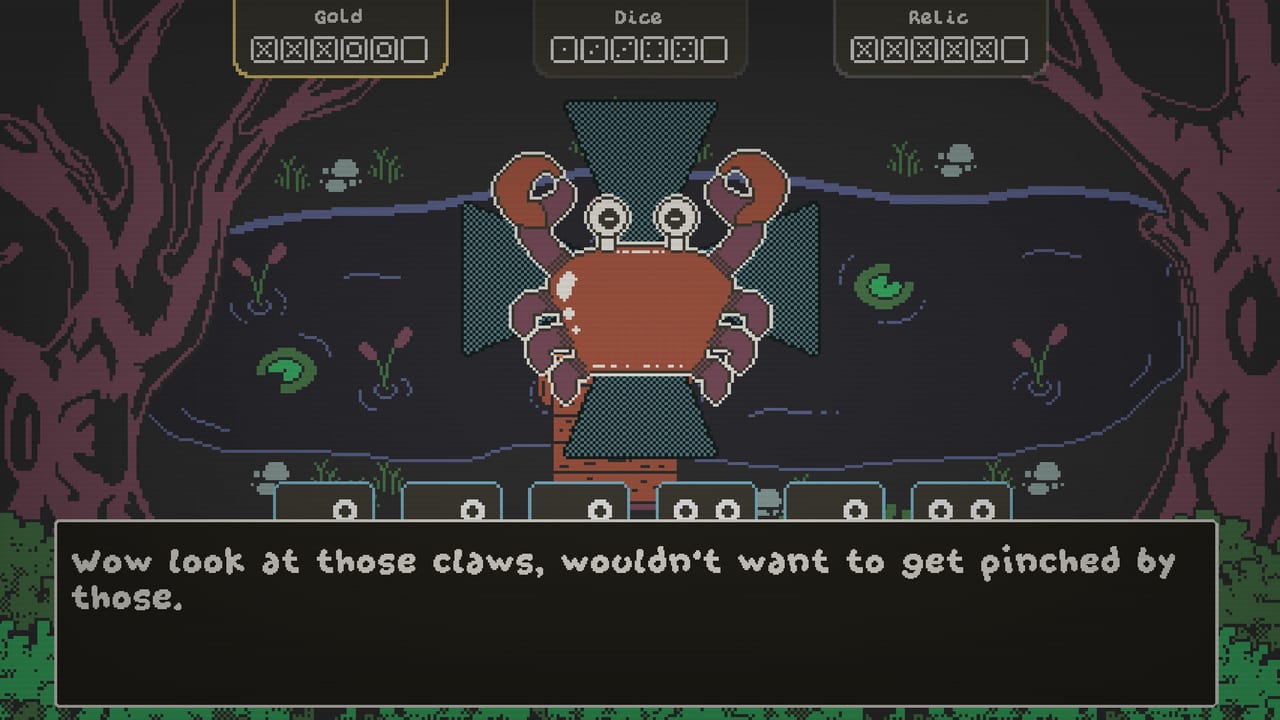
The swamp is full of inhabitants who are not trying to kill you, and some who are. Screenshots show a giant crab standing in a pond with three tracks labeled Gold, Dice, and Relic, each filling boxes as you commit. Another event is a gumball machine: take a Crit capsule (+3% crit chance per Crit) or pay 5G to roll another capsule. These are not flavor text. Crit capsules feed the all-purpose crit system from the combat guide. Gold tracks feed Herc. Dice tracks feed the ten-slot budget.
Demo playthroughs describe a three-die path roll on some splits: 11 or higher takes the top option, 10 or below the bottom. You cannot guarantee the node. You can guarantee you only bet when both outcomes are acceptable. If the top is a forge and the bottom is a trap, do not take that split unless your pool can survive a trap.
Gold versus XP
This is the only macro tension that matters on a first Steam week.
- XP unlocks relics that change the run forever (Fine Cutlery is a second forge; Spirit Jar makes blanks legal).
- Gold buys the die you failed to find in chests and lets you skip a cursed reward for +20G.
- Forge visits convert whatever you already have into something you would roll.
A healthy first area spends one node on a forge, one on a shop, and the rest on fights that you can actually win. Greedy players chain elites, arrive at the boss with 90 gold and a blank-heavy Rapier, and then discover that skipped rewards would have been the real income.
Traps and bad events
The store page mentions dangerous traps next to fishing holes. If an event offers HP now versus a die you do not understand, take the HP when you are below a third of the bar. The Hero’s post-battle heal does not save a 17-damage telegraph. Other characters have different starting relics; do not assume every frog refunds 5 HP. See characters.
A routing mantra
Before you click a node, say: does this give me a face, a relic, or a heal I can name? If the answer is “maybe a funny crab,” take the fight you can read instead. The swamp is replayable because the map is a deck of nodes, not because it is a maze. Learn the node types once, then the tier lists start to pay off on every seed.
Daily runs existed on the Playdate version. Steam 1.0 marketing leans on full campaigns and Swamp Depth rather than a daily seed. Play the campaign first. If a daily mode is in your build, treat it as a puzzle with the same node rules, not as a different game.
Frequently Asked Questions
Quick answers to the most common questions.
What does the 11+ path roll mean?
Some splits roll three dice. A total of 11 or more takes the top node, 10 or less takes the bottom. Only pick those splits when both outcomes are acceptable.
Should I always visit the forge?
Visit when you have blanks to exile or a kill die to pump. Skip when a shop would buy the job your pool is missing. See forging.
Is skipping a die reward for gold good?
Yes when every option is off-plan. Chests show Skip (+20G). That gold buys a shop die that actually matches the run.
What is Swamp Depth?
The hard ladder: stronger enemies, less combat gold, higher shop prices. Route more shops and fewer vanity elites.