Ribbit Rogue Combat Guide
How a turn is won before the dice even leave the pouch.
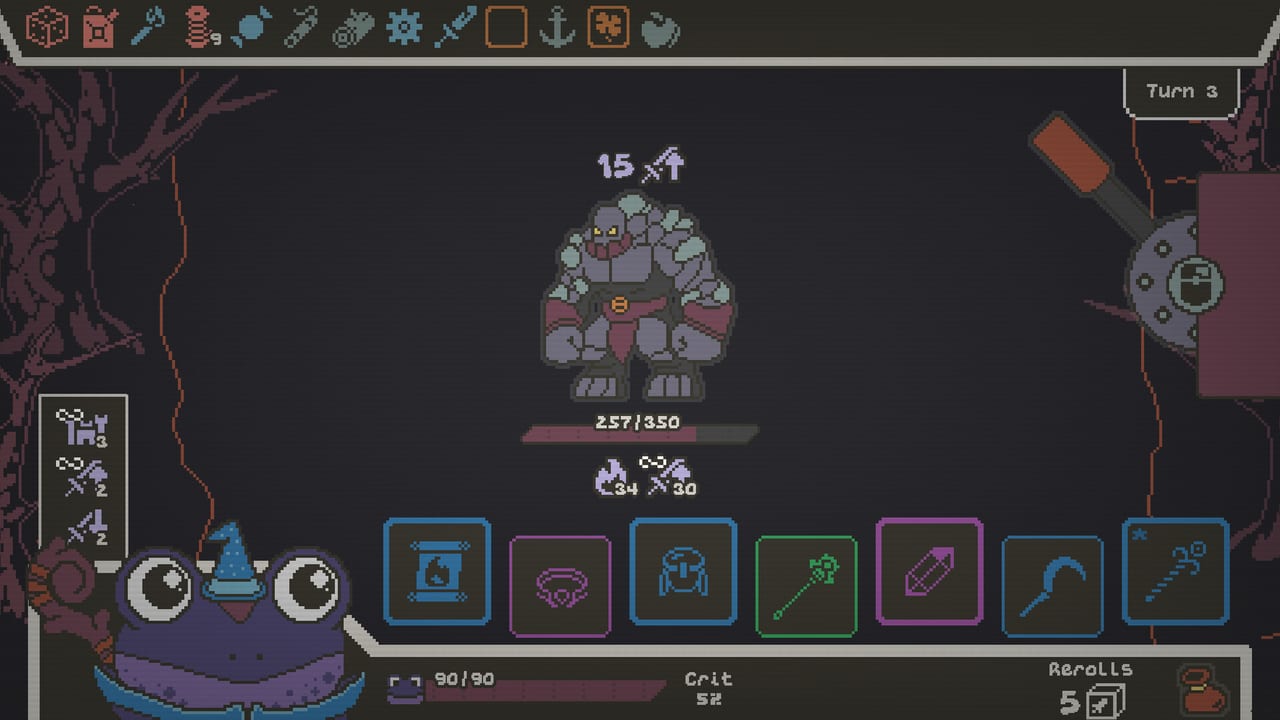
Combat in Ribbit Rogue is a short puzzle with a long memory. Enemies telegraph. You do not. Your job is to look at the intents, pick four dice that can answer those intents, and spend rerolls only on faces that fail the test. This page is the rules of that test. Pair it with forging when the faces themselves are the problem, and with bosses when the HP bars get ugly.
The loop
- Draw seven from the ten-die pool.
- Choose four to roll. The three you leave in the pouch are not gone; they simply do not exist this turn.
- Roll, then reroll individual dice. Rerolls refresh each turn. Official UI shows a reroll counter next to the HP bar.
- Spend the four faces in order. Quick wants to go first. Slow wants to be the last remaining die. Twin repeats the action. Everything else is a number you spend against a telegraph.
- Enemies act according to the icons above their heads — swords, shields, status pips, and mixed plans.
Next Fest recordings of the demo repeat the same teaching line: hold Shift while hovering an enemy or a die to read actions, abilities, and statuses. On mouse, right click rerolls. Do not skip inspect because the art is cute. A 17-damage telegraph on a 66/74 goblin is how 25 HP frogs go home.
Reading the board
Launch screenshots show a typical fight: two goblins with sword intents, a central caster with a 15 shield and a 2-pip plan, your frog portrait in the corner, a 5% crit label, and two rerolls in the bank. Status icons stack on the left. Turn number sits in the top right. That HUD is the whole language of the game. If you cannot name what each enemy will do before you pick the four dice, you are gambling, not playing.
Statuses matter in Steam 1.0. The developer added enemy-targetable statuses during the PC port — bleed, drain, impact, weakness, might, fortify, thorns, and similar tags show up on dice and relics. Drain that heals the enemy when you shield is a trap face; cut it or forge it off. Might that you apply at the start of battle (Cracked Sword does this, with a weakness tax) changes whether you want a slow setup turn.
Quick, Slow, Twin
These three keywords are why action order is a mechanic and not a habit.
- Quick increases its effect if it is the first die you use that turn. Put your biggest attack or your emergency shield here when the telegraph is a one-shot.
- Slow increases its effect if it is the last remaining die. It is a finisher, a last heal, or a last shield after you have already spent the noisy faces.
- Twin repeats the action. Twin plus a fat number is a build. Twin plus a blank is a joke. Boss rewards include a Twin Die that also grants an extra reroll and makes Twin fire three times — that is an engine, not a sidegrade.
Pocket Watch, a relic from the 0.4 patch list, adds effect to Quick and Slow when they activate. Empty Hourglass buffs the final remaining die. If you own either relic, your order is no longer optional.
Crit is not just damage
Ribbit Rogue’s crit is the feature press coverage keeps highlighting for a reason. A crit doubles the effect value of the face: damage, shield, and heal. A defensive frog can still ride crits. The HUD shows a crit percentage (5% in several screenshots). Capsule events can add Crit tokens that grant +3% crit chance per Crit. Relics that add crit chance or that pay you when you crit will define entire runs. Do not spend those relics on a pool that never rolls a number worth doubling.
Rerolls are a resource, not a fidget
You will see blank faces. You will also see faces that are real but wrong — a heal into a fight where nobody is threatening you, a single-target poke into three crabs. Reroll the wrong face. Keep a reroll for the fourth die if your pool is blank-heavy. Relics from the 0.4 list exist entirely to mess with this meter:
- Amulet — extra rerolls on turn one, fewer afterward.
- Spare Pouch — leftover rerolls become +1 next turn.
- Floppy Disk — conserve up to three rerolls between turns.
- Blank Die (boss reward) — more rerolls, and blanks deal damage to a random enemy.
If you own Spare Pouch, ending a turn with a spare reroll is skill. If you do not, spending down to zero to dodge a blank is still correct.
Targeting and multi-enemy math
Some faces cleave. Some hit a random enemy. Some apply thorns or revenge. When three crabs sit at 60 HP with an 8-pip plan, a random hit is a coin flip and a cleave is a schedule. Pick dice before the roll with the enemy count in mind. The dice tier list flags faces that only look strong in a duel.
A turn checklist you can say out loud
- Name every intent.
- Name the HP you must not lose this turn.
- Pick four dice that can produce that shield or that kill.
- Reroll blanks and off-script faces.
- Spend Quick first if you need the spike now; spend Slow last if the relic or keyword pays you.
- Only then look at leftover damage as greed.
New players fail step 2. They roll four attacks into a 17-damage telegraph and call the game unfair. The game told them. Combat in Ribbit Rogue is literacy. Once you can read, builds start to mean something, and the run planner stops being a shopping list.
Frequently Asked Questions
Quick answers to the most common questions.
How many dice do I roll each turn?
You draw seven from a pool of ten, then choose four to roll. Rerolls refresh every turn unless a relic conserves them.
Do crits affect shields and heals?
Yes. A crit doubles the face's effect value, not only damage. Defensive pools still want crit chance.
What do Quick, Slow, and Twin do?
Quick pays extra if used first. Slow pays extra as the last remaining die. Twin repeats the action. Sequence around those keywords.
How do I inspect an enemy?
Hold Shift while hovering (see controls). Check the telegraph before you lock the four dice.