Ribbit Rogue Forging Guide
Turn six random faces into one die you would actually roll.
Forging is the reason Ribbit Rogue is not Slay the Spire with cubes. You do not hunt a perfect die in a reward chest. You hunt parts, then you visit a forge and assemble a die that matches the run. Steam 1.0 keeps the Playdate fantasy and adds a proper forge node, duplicate merges, and relics that let you forge at campsites. If your pool still has two blanks on your “main” attack die, you have not used the system.
The two forge actions
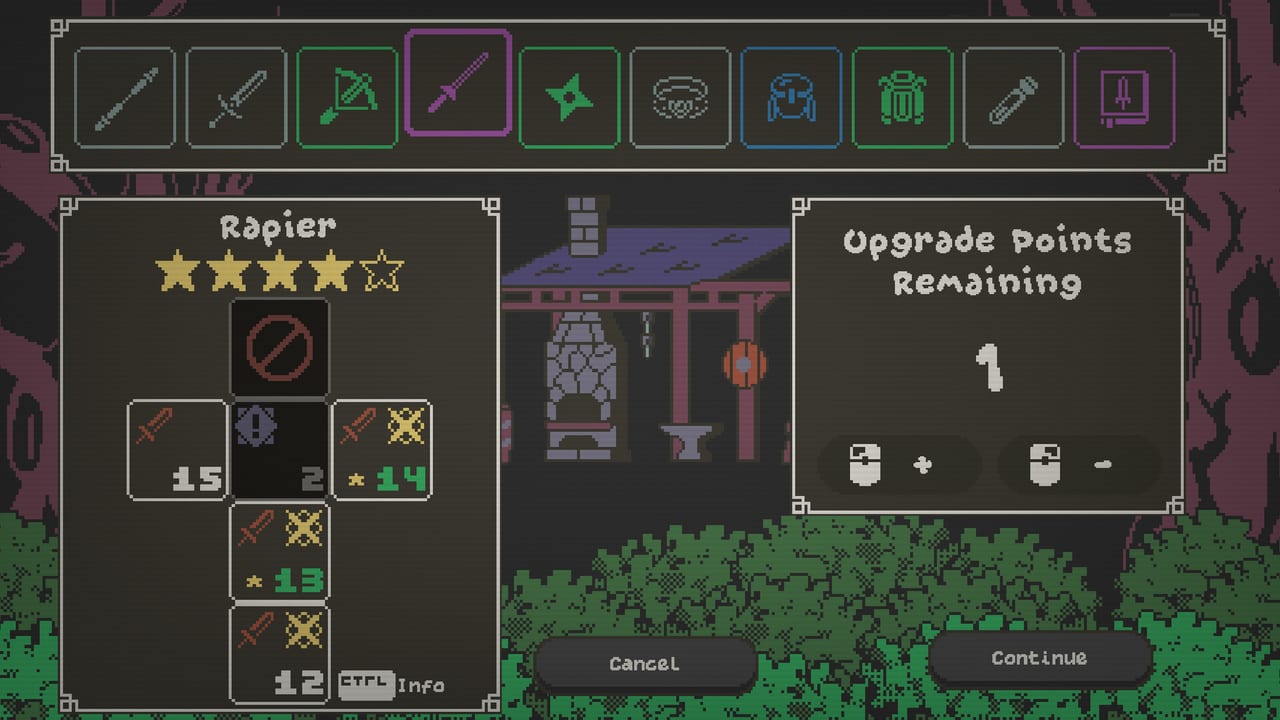
Official UI shows an unfolded die net — the six faces laid out like a cross — next to an Upgrade Points Remaining counter. That screen is doing one of two jobs.
1. Swap a side between two dice
Put two dice on the anvil and exchange a face. This is how you concentrate good attacks onto one die and exile blanks onto a sacrificial die you plan to cut. Japanese launch coverage describes the same loop: you are not searching for a finished product, you are slowly editing six faces.
Swap examples that actually happen:
- Move a 15 attack face from a Rapier onto a die that already has Twin.
- Move a blank from your shield die onto a junk die you will replace at the next chest.
- Move a Slow heal onto a die you always spend last.
2. Spend three upgrade points on one die
The forge can also upgrade a single die. You get three points. Each point adds one to a face’s effect value. Each face can be upgraded a maximum of three times. A Rapier screenshot shows a 15, a 14, a 13, a 12, a 2, and a blank — that blank does not want points. Put the points on the faces you already roll on purpose.
Do not spread one point onto three different faces “for flexibility.” Flexibility is how you still roll a 12 when you needed a 16. Pick the two faces that match your build and dump the points there.
Merging duplicates
When a reward die matches one you already hold, you can merge instead of replacing. Merging upgrades the kept die. Combined with the three-upgrade cap per side, merges are how a starter hatchet becomes a boss tool without finding a five-star Claymore. If the duplicate has a better unique face, swap that face over before you cut the extra copy.
When to walk into a forge
Visit a forge when any of these are true:
- You have two blanks on dice you refuse to cut.
- You just took a four-star die with one god face and five jokes.
- You found Blacksmith Hammer, which lets you forge at campsites.
- You are one elite away from a boss and your main attack still caps at 11.
Skip a forge when your pool is already coherent and the node is blocking a shop you need for a relic or a missing job. Forges do not give gold. Shops and skipped chests do. The map guide is the routing half of this decision.
What forging cannot fix
Forging cannot add a sixth unique keyword that the die never had. It cannot create Twin on a face that is not Twin. It cannot raise a face past the three-upgrade cap. It cannot save a ten-die pool that has no shield and no heal — that is a reward-pick problem, not an anvil problem. If every fight is a coin flip, read combat before you spend another node on upgrades.
Relics that change the anvil
- Blacksmith Hammer — forge at campsites. This relic turns every rest into a mini-edit. Take it if your pool is still a draft.
- Fine Cutlery — permanently upgrade a die side when that side defeats an enemy. It is a slow forge that happens in combat. Pair it with a concentrated attack die, not with a spread of pokes.
- Trick Coin (Heads / Tails) — even or odd faces get +1 effect. After you know which coin you have, upgrade toward even or odd numbers on purpose.
- Boss Twin Die and Blank Die — these are not forge tools, but they change what you forge toward. Twin Die wants copied actions. Blank Die wants you to keep a blank on purpose.
A forge script for the first area
- Name the die that is allowed to be garbage. All blanks migrate there.
- Name the die that is allowed to be the kill button. All big attacks and Twin migrate there.
- Spend the three points only on the kill die or on the shield die, never on the garbage die.
- Cut the garbage die the next time a reward actually matches the run.
- Stop forging for novelty. If the pool already answers telegraphs, take XP or gold instead.
The Playdate version already taught this, but Steam makes it obvious: the unfolded net, the remaining points, Cancel and Continue. Use Cancel if you walked in without a plan. Use Continue only when you can say which face got better. That sentence is the whole skill. For more on which dice deserve the points, see the dice tier list. For a printable version of this script, steal the forge block from the run planner.
Frequently Asked Questions
Quick answers to the most common questions.
What can I do at a Ribbit Rogue forge?
Swap a side between two dice, or spend three upgrade points on one die. Each side upgrades at most three times.
Should I upgrade a blank face?
Almost never. Swap the blank onto a die you plan to cut, or keep it only if a relic like Spirit Jar or Blank Die pays you for blanks.
How do duplicate dice work?
You can merge a matching reward into the die you already own to upgrade it, instead of burning a pool slot.
Can I forge at campsites?
Yes if you have the Blacksmith Hammer relic. Otherwise you need a dedicated forge node.